commercial snow removal estimate
A commercial snow-removal estimate starts with a site brief
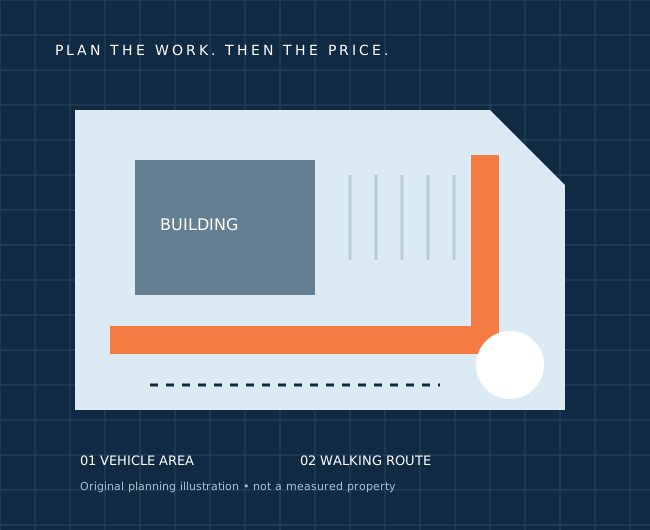
Original IAM explanatory artwork. Not a customer photograph or measured result.
Prepare a clear property brief covering zones, access, snow storage and the details a contractor needs.
Divide the property into service zones
Draw a simple plan of the areas under discussion. Mark vehicle lanes, parking spaces, pedestrian routes, entrances and any other surfaces that may be included. This is a communication sketch, not an engineered plan. Identify boundaries so neighbouring or excluded areas are not accidentally counted.
Attach a broad area estimate and say how you obtained it. If the area is uncertain, label it approximate. A contractor can then decide what needs measuring or inspecting before preparing a proposal.
 01Start with the real scope
Record the inputs beside the number.
Describe access and operating hours
Record normal occupancy and access arrangements. Parked vehicles, locked gates, deliveries or busy entrances can affect how work is organised. Avoid publishing gate codes or sensitive access information on a public enquiry page; arrange a suitable private channel with the contractor.
Identify a property contact who can clarify scope and access. If approval is required from a manager or strata representative, explain that process early. A submitted form does not confirm that the property is accepted or scheduled.
Explain the snow-storage question
Mark the proposed snow-storage area and any places where snow should not be placed. Storage capacity, drainage and visibility require consideration for the actual site. Do not assume a diagram or calculator can establish a suitable location remotely.
Ask whether relocation or off-site hauling needs a separate allowance. If it is outside the proposed scope, keep that exclusion beside the estimate. Otherwise two totals can appear comparable while covering substantially different work.
03Make the next step clearRecord the inputs beside the number.
Prepare a reviewable handoff
Send the plan, relevant permitted photographs, approximate dimensions, desired scope and timing together. Avoid customer or resident details that are unnecessary for the estimate. State what is known and what the contractor still needs to review.
Keep a dated copy of the brief and final proposal. If scope changes, revise the record rather than relying on an old calculator screenshot. The most useful estimate is one whose inputs and boundaries can still be understood later.
Keep exploring
What belongs in a snow removal cost estimate? →
Per-visit or seasonal: compare the same snow service scope →
Margin and markup change a snow-removal estimate differently →